


High above the Pyrenees
 The Pyrenees Mountains form a natural border between France and Spain. From the window of my aircraft the eye catches a spectacular sight. In the row next to me sits a woman with a small dog in her arms, holding and caressing it as if it were a human baby. She puts the head of the dog next to the window and says:
William Wordsworth on Good and Evil
Adam Kirsch in his Dec 5, 2005, review in the New Yorker of Juliet Barker’s new biography Wordsworth: A Life writes that Woodsworth believed that the soul, uncontaminated by wealth and unperverted by extreme poverty, is essentially good; more, that it is part of a universal frame of goodndess, which can also also be glimpseed in mountains and rivers, animals and plants. Sin and death have no dominion over this goodness, which lies just underneath the surface of things, always ready to receive us. To support this interpretation, he provides these lines by the poet:
‘Tis Nature’s law
That none, the meanest of created things,
Of forms created the most vile and brute,
The dullest or most noxious, should exist
Divorced from good—a spirit and pulse
of good,
A life and soul, to every mode of being
Inseparably linked.
In Heaven we are all Celebrities
I personally think that heaven will be like being at the comedy club all day long. But I seem to be alone in that belief. Barbara Walters interviewed big and small people about what they think is going to happen after death. Here is what they said:
By VIRGINIA HEFFERNAN (NYT)
‘Heaven
Continue ReadingTransfixed in the Cineplex
DANIEL MARK EPSTEIN explains in the WSJ review of “The Power of Movies” what happens when we are at the movies.
Seduced, disturbed, beguiled—something strange and compelling happens when we watch a movie: When my daughter was four years old, we took her to see “The Wizard of Oz.” She emerged from the darkness transformed: For the next half-year, we had to set an extra place at the table for the Scarecrow, who had become her constant friend. The girl had gone so deeply into the world of the movie we wondered if she would ever return. Her experience had a certain resonance for me. The first movie I ever saw was “Hans Christian Andersen,” starring the golden-haired Danny Kaye. Since then I have never seriously considered any career other than the writer’s trade. If my first movie had been “High Noon,” would I have wanted to be a gunslinger? Or “The Red Shoes”—would it have made a ballet dancer of me?
Continue Reading
A Good Woman
 For all you fans of Oscar Wilde, here is a movie that you will enjoy. Wilde’s successful play “Lady’s Windermere’s Fan” (1892) was recently turned into a motion picture with Scarlet Johansson and Helen Hunt in the leading role. Not having read Wilde for over a decade, I ravished listening to witty dialogs about marriage and happiness. After watching the movie I browsed through the play to see how faithfully Howard Himelstein adapted the play to the big screen. The movie transplants the action from London to summertime Italy and stretches twenty-four hours, during which the play takes place, over a couple of weeks. I dare say that the film is even better than the original play. Only Scarlet Johansson, who is the latest celebrity with her own perfume line, seems a bit miscast for the Victorian persona of Lady Windermere.
Charlie and the Chocolate Factory
 Charlie is charming poor boy who lives not far from the world largest chocolate factory. Besides mom and dad, the four grandparents stay in Charlie’s small Hansel and Gretel house whose holes in the roof provide Charlie more with a sense of adventure than discomfort. Presenting an unusual picture of inter-family bliss, the four grandparents of Charlie stay in the same bed all day, always ready to support Charlie in his aspirations. A marvelous story teller, Charlie’s grandfather on the left side of the bed used to work in the chocolate factory. He shares with his grandson the dream of visiting the chocolate factory one more time. Together they try to find a way to make it happen. The imagination powering the film is stunning. This is one of the rare films that will please adults and children alike. Bring a piece of chocolate to the show!
The Speckled People: Memoirs of a Half Irish Childhood
 Don Quixote was too heavy a book to haul for a third time across the Atlantic. The taxi already waiting, I quickly grabbed Hugo Hamilton’s childhood autobiography from my bookshelf where it was sitting for the last two years after having received a very good review in one of my favorite news outlets. Having finished the book, it is fair to assume that the reviewer either had special connections to post-World War II Ireland or Germany. These strong emotional ties suspended all critical faculties. The rave review was unwarranted because The Speckled People does not come close to world literature. The book has a few good passages. But unlike the truly pioneering Don Quixote The Speckled People will not withstand the test of time despite having good material to work with. For one, the narrative perspective it adopts does not work.
Winslow Homer at the National Gallery of Art in Washington
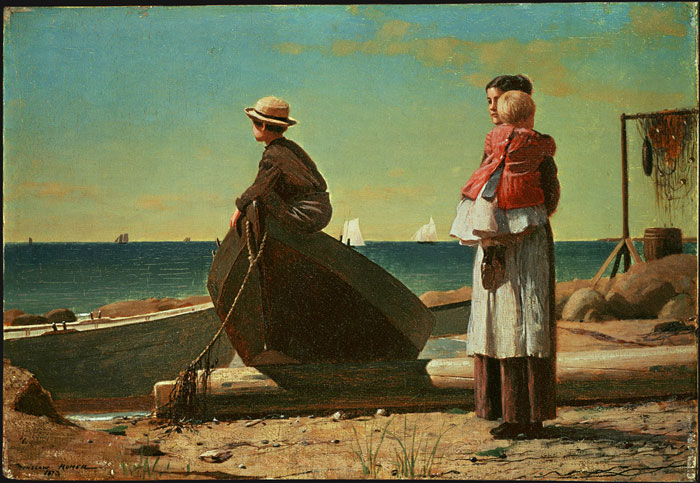
Dad’s Coming 1873. See the Online Catalog of the Exhibit.
Sophie’s Choice
 A few years after the Second World War, a young writer moves from Virginia to New York. Rents are too high in Manhattan. (Doesn’t this sound familiar?). So he settles in Brooklyn, renting a room from an elderly lady in a pink Victorian house that seems to attract eccentric people like a light pulp attracts flies. Among the roomers are Sophie (Meryll Streep) and Nathan (Kevin Kline), who are lovers and quickly become the aspiring writer’s best friends. Our writer fears that he will be without female companionship all his life and since it also may deliver good writing material he decides to fall in love with Sophie. If a triangle relationship is not complicated enough, Sophie and Nathan add drama to this constellation by bringing particularly large pieces of psychological baggage to the mix. Step by step we learn about Sophie’s and Nathan’s backgrounds. Their past is very sad indeed. In the hands of a less gifted storyteller, the movie would have left the viewer deeply depressed. But it does not. This miracle is partly achieved by Meryl Streep’s spectacular performance. Watching her play Sophie is to see one of the best pieces of acting that made it onto the big screen.

© 2026 Peter Murmann. Powered by ExpressionEngine.


